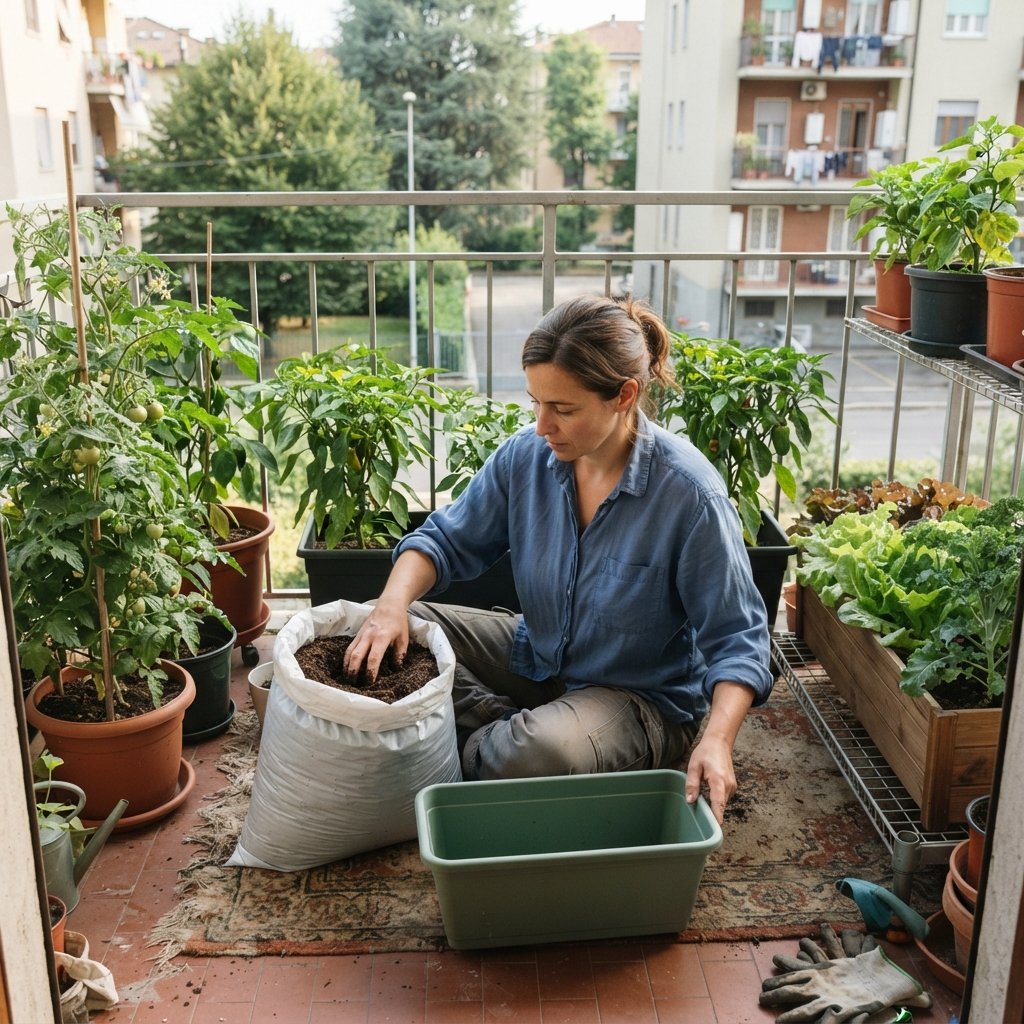
AI-generated illustration.
The best potting mix for container vegetables is lightweight, drains excess water, retains enough moisture without becoming soggy, and provides steady nutrition in a balcony pot. For apartment renters, that means choosing a commercial potting mix or a balanced homemade blend—not filling a pot with straight garden soil; Oregon State University Extension warns that topsoil and general planting mix can be heavy and drain poorly.
This guide covers what ingredients such as compost, peat moss, perlite, and vermiculite contribute, how commercial and DIY mixes differ, and how to match the mix and fertilizer plan to your vegetables. It also explains practical fixes for watering and drainage problems, so you can address those issues without replacing every pot. Related: Self-Watering Containers for Balcony Vegetables.
What a high-performing vegetable container mix needs
The best container growing medium passes four tests: it drains excess water, holds enough moisture between balcony waterings, leaves air around roots, and supplies—or accepts—supplemental nutrients. For a renter, that usually means choosing a lightweight potting mix instead of dense soil, especially for small pots that dry quickly.
The balance between drainage, moisture, and air
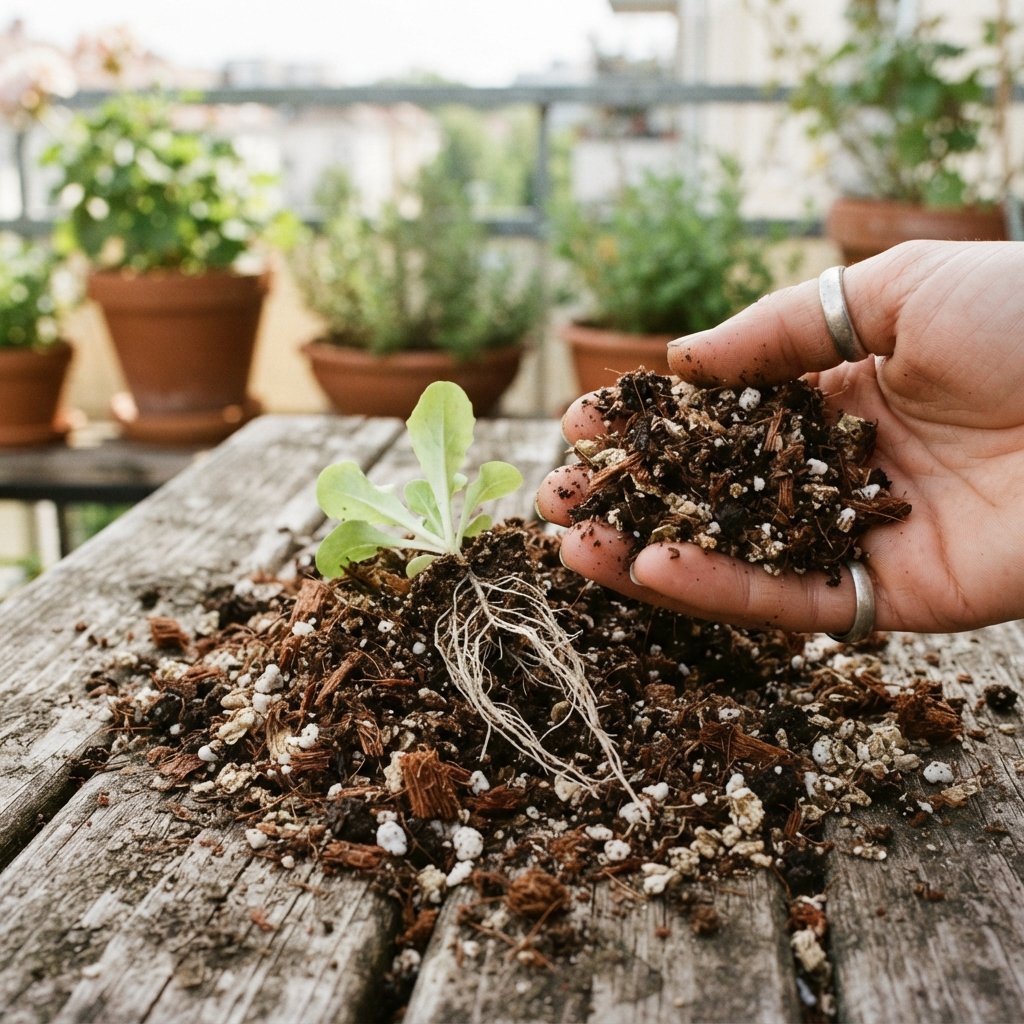
A well-drained potting mix prevents waterlogged conditions, while adequate water retention keeps vegetable plants from wilting soon after watering. These properties work together: roots need water, but they also need open spaces filled with air for root aeration.
Perlite creates these air spaces, while vermiculite helps preserve them and adds moisture-holding capacity. Peat moss, coconut coir, compost, and composted bark each affect water retention and texture differently. No single ingredient is universally best; the balance matters.
For example, a sunny balcony pot may need more moisture-holding material than a shaded pot, but an overly fine mix can stay wet. For broader crop and space decisions, see Planning Vegetable Container Gardening in Small Spaces.
- Perlite: adds lightweight mineral particles that support drainage and create air space.
- Vermiculite: helps hold moisture while maintaining some porosity.
- Peat moss or coconut coir: contributes moisture retention and bulk.
- Compost: adds organic matter and nutrients, although those nutrients are released slowly and may not feed a crop for the whole season.
- Composted bark: contributes structure and organic matter.
How to judge the bag before buying
University of Maryland Extension describes commercial soilless mixes—blends made without garden soil—as commonly containing some combination of sphagnum peat moss, perlite, vermiculite, composted bark, compost, coconut coir, lime, and fertilizer. These mixes have a typical pH, a measure of acidity or alkalinity, of about 6.2; vegetable plants generally grow best from pH 5.5 to 7.0.
- Choose a bag labelled potting mix or soilless mix.
- Look for a lightweight texture and drainage ingredients such as perlite.
- Check the listed pH when available.
- Read whether fertilizer is included and how long its feeding claim lasts.
- Compare the ingredient panel rather than trusting “organic” or other front-label claims; “organic” describes the production or input approach, not an automatic guarantee of ideal texture or nutrition.
Why garden soil and topsoil usually fail in balcony pots
As a general rule, do not use garden soil or topsoil directly in an ordinary balcony container. Garden soil compacts in containers, reducing drainage and aeration, and can pull away from the container wall as it dries.
In a container, that compaction makes garden soil difficult to wet evenly and leaves vegetable roots with less usable air. A self-watering planter reservoir supplies water, but it does not make heavy, compacted soil porous. Lightweight potting soil is usually more reliable for growing vegetables in containers.
- Garden soil: Field soil that may become dense in a pot. Use it in the ground, or only in a carefully amended homemade blend.
- Topsoil: Another field material sold for outdoor beds and landscaping. Topsoil for container gardening is generally unsuitable as the main ingredient because it adds weight and can restrict drainage and aeration.
- Potting mix, potting soil, or container mix: Labels vary, so check the ingredient panel and the product’s texture. A suitable mix is lightweight and porous, often containing peat moss, perlite, vermiculite, compost, or composted bark.
The practical distinction between potting mix and garden soil is not the word “soil” on the bag; it is whether the product is designed to maintain air space in a container. For a budget comparison before buying bags, see the Cost to Start a Balcony Vegetable Garden 2026.
When a little topsoil is acceptable
University of Maryland Extension states that topsoil belongs only in very large containers and should make up no more than 10% of the container’s volume. For example, a very large planter could contain a small, measured portion of topsoil blended through the rest of its growing medium. This does not apply to a typical balcony pot, railing planter, or window box, where added weight and compaction become practical concerns. For most renters, choose a commercial container mix instead.
Commercial mixes, soilless blends, and reliable DIY recipes
For most balcony renters, a commercial soilless potting mix is the simplest choice, while a DIY potting mix gives you more control over texture and ingredients. “Soilless” does not mean nutrient-free: commercial products may contain fertilizer and lime, while some organic potting mixes use organic fertilizers. An extension guide from the University of Maryland lists peat moss, perlite, vermiculite, compost, composted bark, and coconut coir among common ingredients.
Peat, coir, and amendments: choosing a practical base
Peat moss and coconut coir hold moisture in many soilless mixes. Choose between them by checking the product’s texture, wetting behavior, and ingredient panel rather than assuming one base suits every balcony, climate, or watering routine. Perlite helps keep a mix open, while vermiculite holds moisture. Compost and worm castings can contribute organic matter and nutrients.
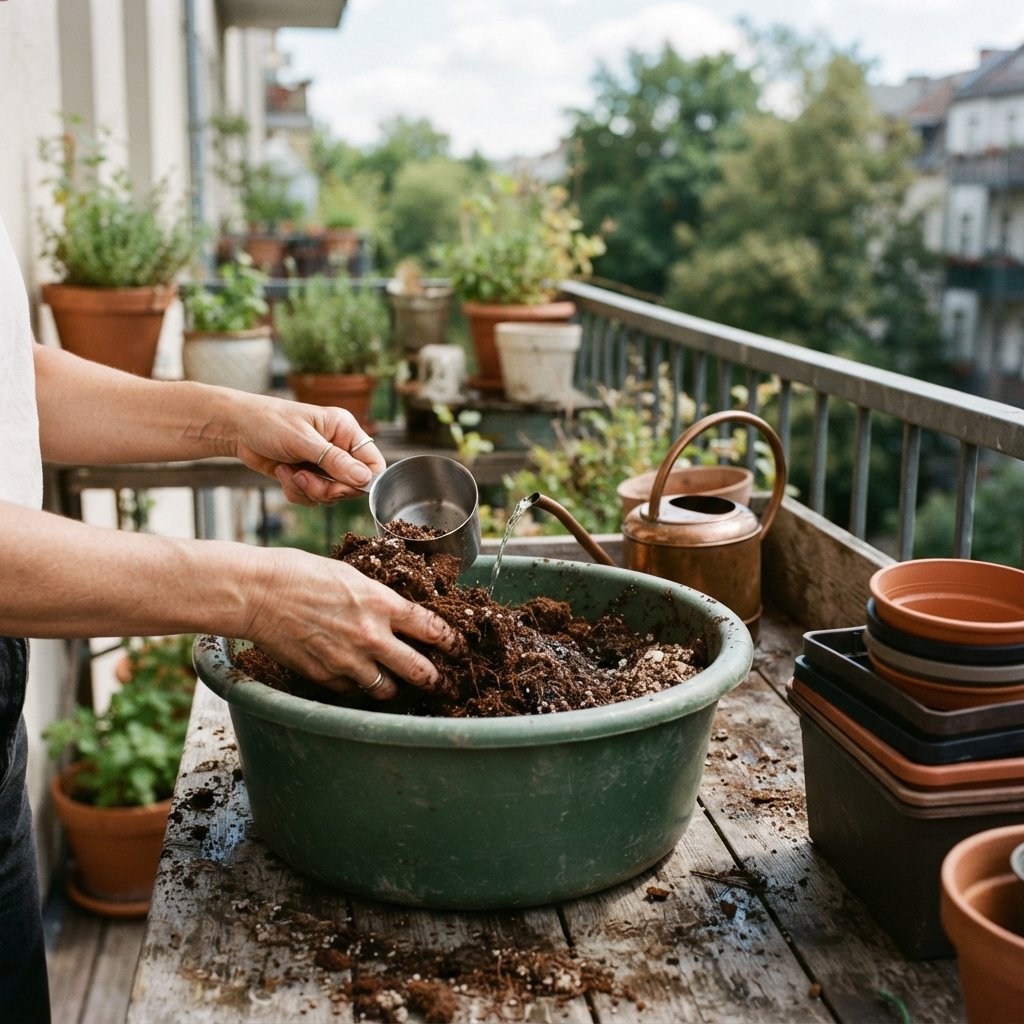
Dry soilless mix can repel water. Before filling pots, moisten it evenly and mix it thoroughly with gloved hands so water reaches the entire root zone.
Choose a bagged mix when convenience, consistent texture, or limited storage space matters. Choose a homemade potting soil blend when ingredients are readily available and you are prepared to manage feeding. Compost releases nutrients slowly and may not supply a vegetable plant for the entire season.
Documented container soil recipe: The Ask Extension recipe uses two parts peat moss, two parts compost, and one part vermiculite.
- Gather peat moss, compost, vermiculite, a measuring container, a clean tub, and water.
- Measure the ingredients in a 2:2:1 ratio.
- Combine them thoroughly in the tub.
- Moisten the mixture evenly before filling pots.
An alternative from UNH Extension uses equal parts vermiculite, peat moss, and high-quality compost. That recipe also lists organic amendments, but it does not establish one fertilizer formula for every crop, so follow the chosen product’s label and avoid adding fertilizer automatically.
Match the mix, pot size, and feeding plan to the crop
Match the potting mix to the container depth: shallow-rooted crops need a balanced, well-drained mix, while larger plants need more growing medium for moisture retention and root support.
- 9–12 inches: Lettuce, radishes, green onions, spinach, chard, kale, and herbs grow well in this range. A compost-containing mix should support these compact crops while preserving root aeration.
- 12–14 inches: Peas, short carrots, eggplant, and peppers need more depth. A potting mix for peppers should drain freely but hold enough moisture to support their deeper root systems.
- 16–18 inches: Tomatoes, potatoes, zucchini, winter squash, beans, and cucumbers need greater depth. A potting mix for tomatoes needs enough volume around the roots to avoid rapid drying; the same depth principle applies to other large plants.
Use a 9- to 12-inch container for salad greens, for example, but move a tomato into a 16- to 18-inch container rather than trying to compensate with extra fertilizer. Follow the crop-selection advice in the balcony vegetable gardening article, and use the self-watering containers guide when moisture management is difficult in a sunny or exposed spot.
A simple feeding routine after planting
Bagged mixes may include starter nutrients, but those nutrients do not necessarily last through a productive container season. Oregon State Extension recommends soluble all-purpose fertilizer at half the labelled strength every three to four days, or dry fertilizer top-dressed about every three weeks.
Warning: Too much fertilizer can burn roots. Follow the product label before applying any fertilizer.
- Choose either soluble all-purpose fertilizer or dry fertilizer.
- Apply soluble fertilizer at half label strength every three to four days, or top-dress with dry fertilizer about every three weeks, following Oregon State Extension’s container-feeding guidance.
How to choose between popular bagged options—and assess Miracle-Gro
Hunker describes a formulation containing forest products or bark, peat moss and/or coconut coir or compost, perlite, fertilizer, and a wetting agent. Since ingredients vary by product and manufacturing location, check the current bag before buying.
Check whether the mix resembles a loose blend of moisture-holding materials, perlite or vermiculite, and composted bark instead of heavy garden soil.
Organic is a choice, not the whole decision
An organic potting mix can suit edible crops, but “organic” alone does not determine performance. Confirm that the bag is intended for containers, then check its ingredients, texture, and nutrient information. Compost and worm castings can contribute nutrients, while peat moss or coconut coir helps hold moisture. The finished mix still needs enough pore space for drainage and root aeration. Choose organic when its inputs and growing qualities match your preference and crop—not simply because the label says organic.
Use this three-question checklist before choosing a bag:
- Read the ingredients. Look for a container-focused blend with materials such as composted bark, coconut coir, perlite, compost, or peat moss.
- Check the nutrient plan. Miracle-Gro’s described slow-release fertilizer is a 21-11-16 formulation, which may reduce immediate feeding, but plant growth still needs monitoring.
- Match the texture to your conditions. Choose a moisture-retentive option for a balcony that dries quickly, but avoid a clumped, gritty, or heavy bag because it can restrict water movement.
Fix common potting-mix problems before replacing everything
Start with the symptom when troubleshooting potting mix: waterlogged container soil usually signals compaction, while potting mix that dries quickly may need more thorough wetting before you change its ingredients.
- Water stays on the surface: Compacted garden soil or another dense medium can restrict drainage and aeration in containers, including aeration around the roots. Do not add gravel as a bottom layer. Instead, improve the mix by distributing porous ingredients such as perlite throughout it.
- The mix dries into gaps: A soilless potting mix can repel water when it dries out. Wear gloves and work water through the mix until it is thoroughly wet. Then water slowly so the root ball receives moisture.
- Vegetable plants grow poorly: Compost and soilless media lose nutrients and physically break down over time. University of Maryland Extension recommends mixing last year’s media 50:50 with fresh growing media and/or compost for the next crop.
Use fresh media for annual vegetables when the previous pot contained pests or disease; refreshing old media is not the right response to those problems. For a watering setup that reduces daily checking, see the self-watering planter guide, but use it alongside correctly structured media.
Conclusion
For most apartment renters, the best potting mix for container vegetables is a lightweight commercial potting or soilless mix. Look for a moisture-holding base, compost or bark, and perlite or vermiculite to improve aeration. Avoid straight garden soil, choose a container deep enough for the crop, and plan to feed regularly.
Choose a mix that stays evenly moist after watering, drains freely, and suits the crop’s container depth. Monitor moisture and feeding before changing ingredients. Check the label before buying, and refresh mix that has broken down; University of Maryland Extension recommends mixing old media 50:50 with fresh media and/or compost. Use fresh mix instead when old media has a pest or disease history.
The facts and figures here were checked against the sources linked in this article on October 31, 2026.

Leave a Reply